
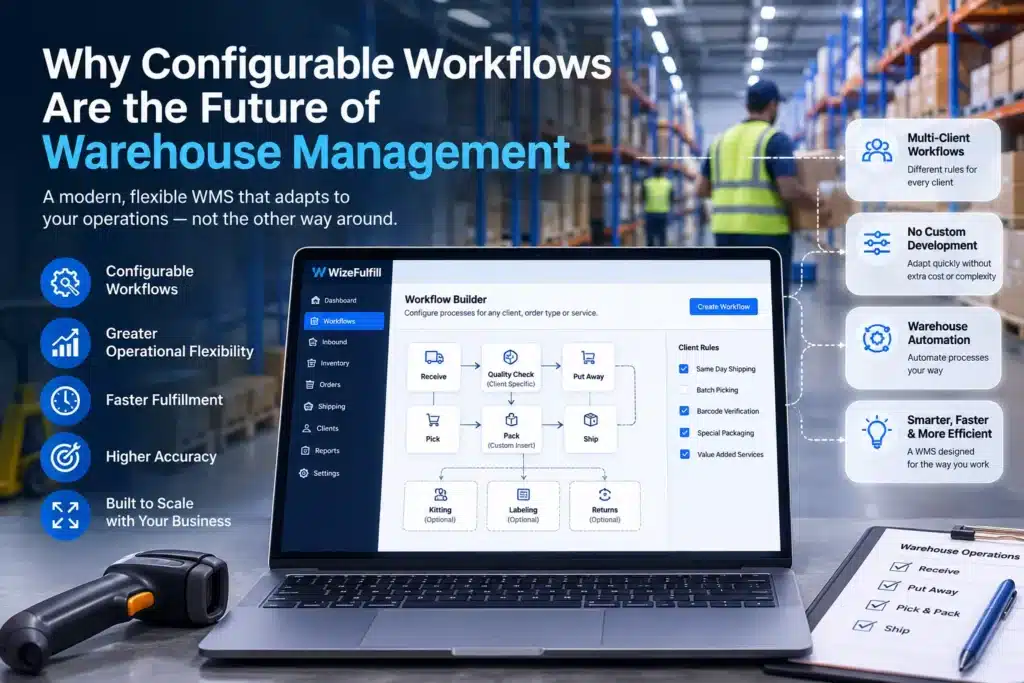


Warehouse operations rarely stay the same.
A warehouse may add new clients, introduce new services, expand to additional locations, change fulfillment requirements, or adopt new processes as the business grows. For 3PL operators, the challenge is even greater because every client may have different inventory, fulfillment, shipping, and billing requirements.
This creates a major problem with traditional warehouse software: rigid systems can force warehouses to change their operations to fit the software. A configurable WMS takes a different approach.
Instead of requiring extensive custom development whenever operations change, a configurable warehouse management system allows businesses to adapt workflows, rules, and processes to meet their operational requirements. As warehouses become more complex, configurable workflows are becoming an increasingly important part of modern warehouse management.
What Is a Configurable WMS?
A configurable warehouse management system (WMS) is software that allows warehouse operators to adjust workflows, business rules, and operational processes without rebuilding the entire system.
Configuration can support changes such as:
- Different workflows for different clients
- Custom receiving processes
- Client-specific order fulfillment rules
- Different picking and packing requirements
- Inventory movement rules
- Warehouse automation rules
- Exception handling processes
- Billing and operational requirements
The goal is not to build completely new software for every warehouse.Instead, the system provides flexibility that allows the warehouse to configure operations around its actual business processes.This is particularly valuable for growing 3PLs and fulfillment providers that manage multiple clients with different requirements.
Why Traditional Warehouse Software Can Become a Problem
Many warehouses initially choose a system based on their current operations. However, warehouse operations evolve.
A 3PL may start with five clients and eventually manage fifty. A fulfillment provider may introduce kitting, subscription fulfillment, returns processing, or new shipping services. A warehouse may expand into new locations or begin supporting new sales channels.
When the software cannot adapt, businesses often face several challenges.
Manual Workarounds
Employees may start relying on spreadsheets, email instructions, and manual processes to handle requirements that the system cannot support.
Expensive Custom Development
Some changes require developers to modify the software.This can increase costs and create delays when the warehouse needs to respond quickly to a new client or operational change.
Inconsistent Processes
When employees create manual workarounds, processes can become inconsistent across the warehouse.
Difficulty Scaling
A system that works for a small operation may become increasingly difficult to manage as clients, orders, SKUs, and warehouse activities increase. A flexible warehouse management system helps reduce these challenges by allowing operations to evolve without constantly replacing or rebuilding the technology.
How Configurable Workflows Improve Warehouse Operations
Configurable workflows allow warehouse operators to define how different activities should move through the operation.
For example, a warehouse may need different workflows for:
- Standard ecommerce orders
- Wholesale orders
- B2B fulfillment
- Subscription boxes
- Kitting and assembly
- Returns
- Damaged inventory
- Priority orders
- Client-specific requirements
Instead of applying one rigid process to every operation, configurable workflows allow the warehouse to create processes that better match operational needs.
1. Different Clients Can Have Different Workflows
This is especially important for 3PL warehouses.
One client may require orders to be picked, packed, and shipped the same day. Another may require additional quality checks. A third client may need kitting or special packaging before an order can be shipped.
A configurable WMS can help warehouses manage these different requirements within one system. This reduces the need to maintain separate spreadsheets, manual instructions, or disconnected processes.
Example
A 3PL warehouse could configure:
Client A:
Receive → Put Away → Pick → Pack → Ship
Client B:
Receive → Quality Check → Put Away → Pick → Add Custom Insert → Pack → Ship
Client C:
Receive → Kitting → Quality Check → Pick → Pack → Ship
The warehouse can maintain client-specific requirements while still operating within a centralized system.
2. Warehouses Can Adapt Faster to Operational Changes
Warehouse operations are constantly changing.
New clients may require different processes. Existing clients may add services. Seasonal demand may require changes to fulfillment workflows.
With a rigid system, every operational change can become a technology project. A configurable WMS helps reduce this dependency by giving operators more control over how workflows are structured. This allows warehouses to adapt faster when requirements change.
3. Configuration Can Reduce the Need for Custom Development
Custom software development can be expensive and time-consuming.
While some businesses require highly specialized functionality, many operational requirements can be addressed through configurable rules and workflows.
For example, a warehouse may need to change:
- Task sequences
- Client-specific workflows
- Operational rules
- Order processing requirements
- Inventory processes
- Automation triggers
A configurable warehouse management system can allow these adjustments without requiring the entire application to be rewritten.
The result is greater operational flexibility and less reliance on custom development for every process change.
Configurable Workflows and Warehouse Automation
Configuration and automation work together.
Automation determines which activities can happen automatically, while configuration determines how and when those automation rules should apply.
For example, warehouse workflow automation could trigger actions based on:
- A new order being received
- Inventory reaching a certain threshold
- A specific client requirement
- An order priority level
- A shipping deadline
- A product type
- A warehouse exception
The ability to configure these workflows allows warehouses to automate processes while maintaining control over how the automation operates.
This is important because not every warehouse or every client follows the same process.
Why Configurable Workflows Matter for 3PL Warehouses
A 3PL warehouse does not simply manage one company’s inventory.
It may manage dozens or hundreds of clients, each with different requirements.
These differences can include:
- Receiving procedures
- Storage requirements
- Order processing rules
- Shipping preferences
- Packaging instructions
- Value-added services
- Returns processes
- Reporting requirements
- Billing structures
Trying to manage all of these requirements through one rigid workflow can create operational problems.
A configurable 3PL WMS allows warehouse operators to support different processes while maintaining centralized visibility and control. This flexibility becomes increasingly important as the number of clients and services grows.
Configurable WMS vs. Custom Warehouse Software
There is an important difference between configurable software and fully custom software development.
| Configurable WMS | Fully Custom Software |
| Uses existing platform capabilities | Built specifically for the business |
| Changes can often be made through configuration | Changes may require developers |
| Faster to adapt to common operational changes | Development can take longer |
| Designed for flexibility | Designed around specific requirements |
| Easier to scale standardized processes | May require ongoing development |
A configurable WMS does not eliminate the need for customization in every situation.
However, it can significantly reduce the number of situations where businesses need to build entirely new functionality.
The goal is to provide a system flexible enough to support operational changes without making every change a software development project.
Key Areas That Should Be Configurable in a WMS
When evaluating a flexible warehouse management system, businesses should consider which parts of the operation can adapt as requirements change.
Important areas may include:
Client-Specific Workflows
Different clients should be able to operate according to their own requirements.
Inventory Processes
Warehouses may need different receiving, putaway, replenishment, or inventory control processes.
Order Fulfillment Rules
Order workflows may vary based on the client, order type, priority, sales channel, or service level.
Automation Rules
Operators should be able to define triggers and actions that support their operational processes.
Exception Management
The system should support workflows for damaged inventory, missing items, order holds, and other operational exceptions.
Value-Added Services
Warehouses offering services such as kitting, labeling, repackaging, or assembly may require specialized workflows.
The more easily these processes can adapt, the easier it becomes for a warehouse to respond to changing business requirements.
How Configurable Workflows Help Growing Warehouses Scale
Growth creates complexity.
As a warehouse adds more clients, SKUs, employees, orders, and services, operational processes become more difficult to manage.
Without flexible technology, growth can lead to:
- More spreadsheets
- More manual instructions
- More exceptions
- More training requirements
- More operational errors
A configurable WMS provides a framework for managing this complexity.
Instead of creating an entirely new process every time the business changes, operators can adjust workflows within the existing system.
This makes it easier to standardize operations where appropriate while maintaining flexibility where clients or processes differ.
The Future of Warehouse Management Is Adaptability
The future of warehouse management is not simply about adding more features. It is about building technology that can adapt to the way warehouses actually operate. Warehouses need systems that can support changing requirements without creating unnecessary complexity.
For 3PLs, this is particularly important. New clients bring new requirements. Existing clients change. New fulfillment services are introduced. Sales channels evolve. Warehouse operations expand. A rigid system can eventually become a limitation.
A configurable WMS provides a more flexible approach by allowing warehouse operators to adjust workflows and processes as their business evolves.
The best warehouse technology should not force an operation into a predefined process. It should provide the flexibility to configure technology around the operation.
Build Warehouse Workflows Around Your Operations
Every warehouse operates differently. Every 3PL client may have different requirements. That is why flexibility should be an important consideration when evaluating warehouse management software.
WizeFulfill is designed to help warehouses configure workflows, manage inventory, and streamline fulfillment operations without adding unnecessary complexity.
With decades of fulfillment industry experience behind its approach, WizeFulfill focuses on a simple principle: Technology should adapt to warehouse operations not force warehouse operations to adapt to technology.
If your warehouse is managing changing workflows, multiple clients, or increasingly complex fulfillment requirements, a configurable WMS can provide the flexibility needed to adapt and scale.