
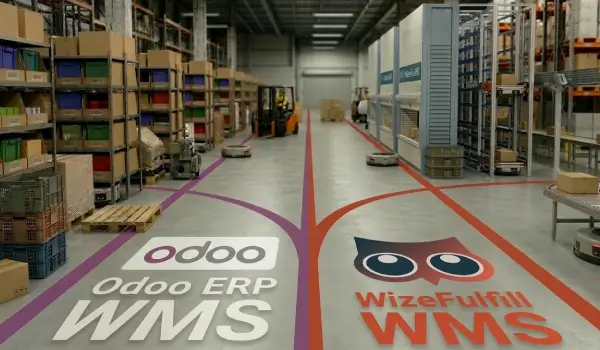


Warehouse software shapes how goods move, orders ship, and inventory stays accurate. Many businesses now compare Odoo ERP WMS vs WizeFulfill WMS before choosing a system. Both tools support warehouse workflows, but they approach operations differently.
One sits inside a broader ERP WMS structure, while the other focuses fully on warehouse execution. Companies exploring Odoo ERP often start with its broader business platform, which connects finance, sales, and inventory.
On the other hand, WizeFulfill centers on operational efficiency and advanced WMS capabilities. Understanding Odoo ERP WMS vs WizeFulfill WMS helps leaders select the platform that matches their warehouse goals.
What is WizeFulfill WMS?
WizeFulfill 3PL WMS is a warehouse-focused platform built specifically for fulfillment operations. Unlike systems where the warehouse tool appears as a WMS module within enterprise software, WizeFulfill centers entirely on execution and operational control. The system includes advanced WMS features that support:
- Receiving
- Picking
- Packing
- Shipping
- Inventory accuracy
Its analytics layer strengthens Warehouse intelligence by providing clear operational visibility for managers and operators.
Businesses often evaluate it during the Odoo ERP WMS vs WizeFulfill WMS decision process because it focuses on speed, workflow simplicity, and high-volume fulfillment performance rather than broader enterprise management capabilities.
WizeFulfill Pros
WizeFulfill focuses entirely on warehouse operations. Its architecture supports high-volume fulfillment environments and multi-client warehouses. Many teams searching for deeper operational visibility prefer tools with Warehouse Intelligence. WizeFulfill emphasizes efficiency, quick onboarding, and warehouse-specific workflows that traditional ERP WMS solutions often approach more slowly.
Warehouse-Centric Design
WizeFulfill was built for warehouses from the ground up. Its workflows support receiving, picking, packing, and shipping without unnecessary layers. This focus makes daily tasks easier for warehouse teams. Unlike platforms where the WMS module sits inside a broader system, WizeFulfill prioritizes warehouse performance first.
Operator-Friendly Interface
Warehouse staff interact with the system all day. WizeFulfill simplifies screens and actions to reduce confusion. Workers scan items, process orders, and update inventory quickly. A clean interface helps new employees adapt faster, which matters in busy fulfillment centers.
Embedded Intelligence
Data matters in modern logistics. WizeFulfill includes built-in analytics and reporting features. These tools support Warehouse intelligence by showing trends in order flow, inventory movement, and operational bottlenecks. Managers gain clearer visibility into performance without exporting data to external systems.
Fast Implementation
Some warehouse platforms require long configuration cycles. WizeFulfill usually deploys faster because its design targets fulfillment operations directly. Companies that adopt it often move from setup to active use within weeks rather than months.
Multi-Client Agility
Third-party logistics providers manage multiple clients in one facility. WizeFulfill handles multi-tenant environments effectively. Separate inventory, order flows, and reporting to stay organized. This flexibility makes it suitable for 3PL operations and fast-growing fulfillment providers.
WizeFulfill Cons
Despite strong warehouse capabilities, WizeFulfill does not replace a full enterprise platform. Businesses evaluating Odoo ERP WMS vs WizeFulfill WMS often consider how much functionality exists outside the warehouse.
Limited ERP Scope
WizeFulfill focuses on fulfillment operations. Financial management, CRM functions, and enterprise planning typically exist in separate platforms. Companies searching for ERP + WMS or ERP + WMS + CRM solutions may require additional systems.
Integration Overhead
Because WizeFulfill specializes in warehouse execution, it usually connects with other software. Integration work may involve APIs or middleware. Organizations that prefer a single unified platform sometimes lean toward broader Odoo software deployments.
What is Odoo ERP WMS?
Many companies exploring warehouse software start by asking what Odoo ERP is and how it supports logistics operations. Odoo software includes an integrated WMS module that manages inventory, order fulfillment, and warehouse workflows inside a larger ERP WMS environment.
Businesses run purchasing, accounting, sales, and logistics within one system. This setup supports unified operations through ERP + WMS architecture and can expand further into ERP + WMS + CRM processes. Inventory movements update across departments automatically.
The warehouse system tracks stock locations, transfers, and shipments while remaining connected to broader business management tools within the same platform.
Odoo Pros
Odoo offers a wide enterprise system that combines several business functions in one environment. Organizations researching what Odoo ERP is often see it as a flexible platform connecting accounting, CRM, and logistics. Its warehouse functionality exists inside a larger system structure.
All-in-One Platform
One reason companies adopt Odoo is its unified architecture. Businesses run finance, sales, and logistics through the same platform. This structure supports ERP + WMS environments and can extend further into ERP + WMS + CRM workflows.
Inventory updates automatically affect financial records and customer orders. Many organizations value this direct connection between departments.
High Customization
Odoo software offers a modular architecture. Companies activate only the applications they require. Developers can also extend the system using custom modules.
This flexibility allows organizations to adjust the WMS module to match their internal processes. Customization supports industries with specialized inventory workflows.
Strong Inventory Modeling
Odoo handles complex inventory structures effectively. Warehouses track stock across locations, warehouses, and product variants. Businesses with layered supply chains often appreciate this level of control.
Inventory data connects directly with procurement, accounting, and sales systems. These connections support integrated ERP WMS operations across the company.
Odoo Cons
Even with strong flexibility, Odoo’s broader scope introduces certain trade-offs. Businesses evaluating Odoo ERP WMS vs WizeFulfill WMS often examine these factors carefully.
Steeper Learning Curve
Because Odoo covers many business processes, new users may face a longer learning period. Warehouse operators sometimes require additional training when interacting with systems designed for multiple departments.
Slower Adaptation
Changes inside enterprise systems can take time. Adjustments to the WMS module may involve testing across accounting, procurement, or sales features. This broader scope sometimes slows warehouse-specific updates.
Roadmap Dilution
Odoo evolves across many industries and modules. Development efforts are distributed across CRM, finance, HR, and inventory. As a result, warehouse improvements may progress more gradually compared with platforms dedicated to advanced WMS functions.
Odoo ERP WMS vs WizeFulfill WMS: Key Differences
Odoo is an ERP suite with a solid WMS module, while WizeFulfill is a specialized warehouse and fulfillment platform. For a warehouse-centric operation, WizeFulfill typically delivers deeper operational depth, speed, and usability.
Core Positioning
| Aspect | Odoo (Inventory/WMS) | WizeFulfill |
|---|---|---|
| Product type | Full ERP suite with inventory/WMS as one module among many apps (sales, accounting, CRM, etc.). | Best-of-breed WMS and order-fulfillment SaaS focused on warehouse and 3PL/e-commerce operations. |
| Target user | Firms want an all-in-one business platform that can also manage warehouses. | High-volume e-commerce, 3PLs, and complex warehouses where fulfillment performance is strategic. |
| Design center | Enterprise processes, modular ERP, custom development. | Warehouse operators, fast onboarding, configurable workflows, and operational guidance. |
Functional Depth And Workflows
| Area | Odoo | WizeFulfill |
|---|---|---|
| Warehouse modeling | Flexible locations (zones → bins), routes, multi-warehouse, smart replenishment, and stock moves. | Multi-warehouse and multi-client setup with focused configuration for warehouses, clients, SKUs, customers, suppliers, and roles. |
| Inbound & inventory | Supports receiving, put-away, internal moves, batch/lot tracking, replenishment rules, and MTO flows. | Smart inbound with ASNs, POs, transfers, adjustments, cycle counts, and receiving reports tuned for accuracy and speed. |
| Outbound & fulfillment | Handles picking, packing, shipping flows, and multi-step routes; advanced scenarios often need partner customization. | Fast order-to-shipment flow with sales orders, fulfillment requests, outbound shipments, and shipment reports built for e-commerce/3PL. |
| Automation & rules | Strong configuration engine, but complex routing/automation commonly requires custom dev or partner modules. | No-code/low-code style workflows, job types, and automation rules designed to let ops teams adapt processes without engineers. |
| Usability on the floor | Powerful but can be complex; often described as having a learning curve and benefiting from expert partners. | “Easy-to-learn” UI for operators, with real-time inventory, automatic order handling, barcode workflows, and quick onboarding. |
Integration, Extensibility, And Intelligence
| Aspect | Odoo | WizeFulfill |
|---|---|---|
| Ecosystem & extensibility | Huge app marketplace; open source code; can add CRM, accounting, marketing, HR, etc., around WMS. | Integrations aimed at marketplaces, ERPs, returns systems, carriers, and other fulfillment-adjacent tools via workflows and automation. |
| Native integrations | Can integrate with couriers, online stores, external ERPs, and accounting via modules/APIs; some shipping and marketplace features require extra apps. | Positions itself as a hub for multichannel tracking and carrier/marketplace connections, with implementation geared to “connect in a few clicks. |
| Analytics | ERP-wide reporting plus WMS analytics on moves, stock, etc., is good for financial and inventory visibility. | Operational dashboards, inventory overview, and advanced reporting focused on day-to-day warehouse performance and client/service metrics. |
| “Intelligence” features | Logic is mainly through rules, routes, and customizations; AI capabilities depend on added modules/partner solutions. | Explicit “Warehouse Intelligence” pillar (WizeHelp/WizeAssist) to monitor operations, surface issues, and guide teams in real time. |
Cost, Implementation, And Complexity
| Dimension | Odoo | WizeFulfill |
|---|---|---|
| Licensing/fees | Per-user and per-app pricing; WMS involves Inventory plus other apps (e.g., Sales), costs scale with users and added modules. | SaaS WMS pricing (not detailed publicly), optimized for warehouses using it as their execution layer rather than a full ERP replacement. |
| Implementation effort | Can be cost-effective, but advanced WMS scenarios often require significant partner work and custom development. | Markets’ “quick and efficient onboarding,” with configuration-driven setup aimed at getting warehouses live fast. |
| Change management | Process changes may touch multiple apps (Inventory, Sales, Accounting), so change cycles can be slower and more cross-functional. | Designed so warehouse and 3PL teams can adjust workflows and rules with minimal engineering, supporting continuous improvement. |
WizeFulfill is Here To Help You Out!
Choosing between Odoo ERP WMS and WizeFulfill WMS depends on operational priorities. Companies that prefer unified business software often choose Odoo software because it combines finance, sales, and logistics within a single ERP WMS structure. Others prioritize specialized fulfillment tools that deliver deeper Warehouse intelligence and operational focus.
Warehouses handling high order volumes often benefit from purpose-built platforms. Meanwhile, organizations seeking ERP + WMS or ERP + WMS + CRM environments may prefer broader enterprise systems.
Both systems offer value, yet their philosophies differ. Understanding these differences helps organizations select the platform that aligns with warehouse scale, integration strategy, and operational goals.
WizeFulfill delivers powerful warehouse technology consulting and implementation services that help businesses deploy scalable WMS solutions and optimize fulfillment operations.
FAQs
-
What is the main difference between WizeFulfill and Odoo WMS?
WizeFulfill focuses entirely on warehouse execution and operational visibility. Odoo provides broader business management through Odoo software, where warehouse tools operate inside a larger ERP WMS system.
-
Is WizeFulfill suitable for third-party logistics companies?
Yes. WizeFulfill supports multi-client warehouse environments. Its operational structure allows different clients, inventory sets, and workflows to run in the same facility while maintaining accurate tracking and reporting.
-
Can Odoo manage warehouse operations effectively?
Yes. The WMS module within Odoo software supports inventory tracking, receiving, picking, and shipping workflows. Many organizations use it as part of a larger ERP + WMS environment.
-
Which platform deploys faster?
Deployment speed often depends on project scope. WizeFulfill usually launches faster due to its warehouse-specific design, while Odoo implementations may take longer because of enterprise-wide integrations.
-
Which system supports better warehouse analytics?
Platforms that emphasize advanced WMS capabilities typically deliver deeper operational insights. WizeFulfill includes built-in reporting and dashboards that support stronger warehouse intelligence across fulfillment activities.