
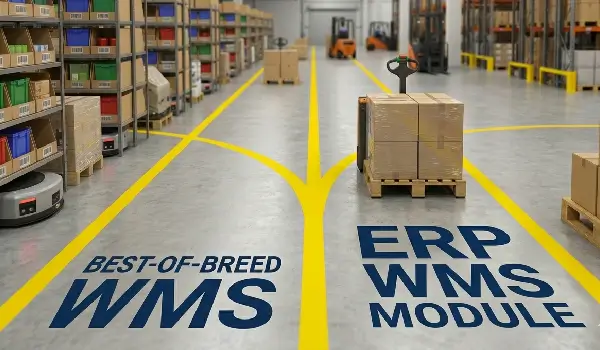


Choosing between best-of-breed WMS and ERP WMS can feel like standing at a fork in the road. Both manage warehouse operations, yet they serve different goals. Some businesses need deep warehouse control. Others want one system for everything.
The debate around ERP vs Best-of-Breed WMS continues because every company runs differently. Cost, scale, and growth plans matter. The discussion of The ERP Warehouse Module vs. Best-of-Breed WMS often comes down to flexibility and control.
This guide breaks it down in simple terms so you can decide what truly fits your warehouse and long-term plans. Let’s start by getting a better idea of what both these software have to offer.
What is Best-of-breed WMS?
A best-of-breed WMS is a warehouse management system built only for warehouse operations. It focuses on inventory tracking, picking, packing, slotting, and labor control.
Unlike general systems, it goes deep. It handles barcode scanning, RFID, automation tools, and advanced reporting with strong detail. Many best-of-breed WMS systems integrate with robotics and conveyor systems easily.
Businesses choose this option when warehouse performance directly impacts revenue. It gives strong operational control. It also adapts well to complex workflows. Some companies even connect it to platforms like Odoo WMS for added flexibility while keeping warehouse focus sharp.
What is ERP with the WMS Module?
An ERP WMS is part of a larger enterprise resource planning system. It connects warehouse management with finance, HR, sales, and procurement.
This setup keeps everything inside one software platform. Data flows across departments without extra connectors. Many growing businesses prefer this model for simplicity.
In the debate of the ERP warehouse module vs. best-of-breed WMS, ERP WMS stands out for centralized control. However, warehouse features may not be as advanced as standalone systems. Solutions like Odoo WMS offer ERP-based warehouse modules that suit small to mid-sized operations.
Core Comparison: ERP Warehouse Module vs. Best-of-Breed WMS
Selecting between an ERP Warehouse Module and a Best-of-Breed (BoB) WMS is a classic debate of “breadth vs. depth.” While an ERP module offers seamless integration across the entire business, a Best-of-Breed WMS provides the surgical precision needed for complex, high-volume logistics. To make things easy for you, here is a comprehensive analysis of them.
| Feature | ERP Warehouse Module | Best-of-Breed WMS |
|---|---|---|
| Primary Focus | General business integration (Finance, HR, Sales). | Specialized, deep warehouse optimization. |
| Integration | Native: Built-in to the existing suite; no complex interfaces. | Complex: Requires APIs or middleware to talk to the ERP. |
| Functionality | Basic: Picking, packing, and shipping. | Advanced: Task interleaving, slotting, and labor management. |
| User Interface | Often consistent with other ERP screens; generalist. | Highly optimized for mobile/RF guns and floor speed. |
| Real-Time Data | Updated, but often tied to transactional processing. | True real-time, sub-second updates for floor activities. |
| Implementation | Faster if the ERP is already in place. | Longer; requires custom mapping and integration. |
| Cost (Initial) | Usually lower; often part of existing license. | Higher, separate license and implementation fees. |
| Scalability | Good for growing businesses with simple needs. | Essential for massive volumes and multi-site operations. |
| Upgrades | Tied to the ERP’s upgrade cycle. | Independent; allows for faster logistics innovation. |
| Automation Support | Limited support for complex robotics/AGVs. | Deep integration with Material Handling Equipment (MHE). |
When to Choose Best-of-Breed (BoB)
A best-of-breed WMS works best for businesses that rely heavily on warehouse speed and precision. It suits companies with large inventory volumes, automation tools, and strict service levels. Below are scenarios where this option makes practical sense.
High Complexity
Large warehouses face layered workflows. Multiple zones with High SKU counts and Fast order turnover. Best of breed WMS systems handle such environments with advanced slotting, wave picking, and labor tracking.
They provide deep visibility into operations. Businesses that face constant operational pressure often prefer this route in the ERP vs. Best of Breed WMS discussion.
Hardware Integration
Warehouses using robotics, conveyors, AS/RS systems, or IoT scanners require tight hardware communication. A Best-of-breed WMS connects easily with these tools.
It sends real-time instructions to machines. ERP modules may offer integration, yet depth can vary. Hardware-heavy facilities usually lean toward standalone systems for smoother execution.
Specific Industry Needs
Pharma, food, and cold storage operations demand compliance and traceability. Best-of-breed WMS systems often include batch tracking, expiration control, and audit logs. These features protect product integrity. In industries where mistakes are costly, the added specialization matters.
Quick ROI
Efficiency drives revenue. Faster picking means faster shipping. A best-of-breed WMS improves accuracy and reduces labor waste quickly. Many companies report visible gains within months. While ERP systems offer broader value, focused warehouse upgrades sometimes deliver quicker operational returns.
When to Choose an ERP WMS Module
An ERP WMS fits companies that value simplicity and unified control. It supports steady warehouse needs without requiring advanced customization. For many small and mid-sized firms, this structure provides a balance between cost and functionality.
Unified Platform
An ERP WMS keeps finance, purchasing, and warehouse data in one place. Managers see the full picture instantly. Sales orders connect directly to inventory.
Reports pull from shared data. In the ERP Warehouse Module vs. Best-of-Breed WMS comparison, this unified structure appeals to businesses that prefer centralized control.
Lower Initial Cost
Standalone systems can require higher licensing and integration costs. ERP modules often come bundled. This lowers upfront investment. For companies managing tight budgets, ERP WMS becomes a practical starting point in the ERP vs. Best of Breed WMS choice.
Simplicity
Smaller operations may not require advanced slotting or automation controls. ERP WMS handles basic inventory tracking, shipping, and receiving smoothly. Many businesses using Odoo WMS appreciate its clean setup and manageable interface. Simplicity reduces training time. Teams adapt faster.
Limited IT Resources
Not every company has a large IT team. Managing separate systems demands technical oversight. ERP WMS reduces that burden. Updates, maintenance, and security remain under one vendor. For companies with lean tech support, this matters.
WizeFulfill is Here To Help You Out
Choosing between best-of-breed WMS and ERP WMS depends on your warehouse goals. Deep functionality favors standalone systems. Unified management supports ERP modules. The ERP vs. best of breed WMS decision should align with growth plans, not trends. Strong evaluation today prevents costly shifts tomorrow.
WizeFulfill delivers practical warehouse solutions aligned with your growth goals, ensuring smooth system selection and confident long-term performance.
FAQs
-
What is the main difference between Best-of-breed WMS and ERP WMS?
A Best-of-breed WMS focuses entirely on warehouse operations with advanced features like automation support and detailed reporting. ERP WMS is part of a broader system that manages finance, HR, and sales alongside warehouse tasks. The choice depends on operational depth versus centralized control needs.
-
Is Best-of-breed WMS more expensive than ERP WMS?
Best-of-breed WMS can involve higher upfront costs due to licensing, integrations, and specialized features. ERP WMS often comes bundled within an existing ERP system, reducing initial expenses. However, long-term value depends on operational efficiency, scalability, and warehouse performance requirements.
-
Can ERP WMS handle complex warehouse operations?
ERP WMS works well for small to mid-sized warehouses with straightforward processes. For highly complex environments involving robotics, multi-zone picking, or advanced slotting, a Best-of-breed WMS usually provides deeper functionality and stronger operational control.
-
Is integration easier with ERP WMS?
ERP WMS offers easier internal integration because warehouse data connects directly with accounting, procurement, and sales modules. Best-of-breed WMS may require third-party connectors for full system alignment, but it often integrates better with warehouse hardware and automation tools.
-
Which system scales better as a business grows?
Best-of-breed WMS typically scales well in high-volume, automation-driven environments. ERP WMS scales effectively across departments as business functions expand. The right option depends on whether warehouse performance or company-wide system unity is the top priority.